


If you trade using borrowed funds through a broker’s Margin Trading Facility (MTF), the interest rate you’re charged is one of the most overlooked — and most expensive — costs in your entire trading journey. Brokerage fees get all the attention, but MTF interest is charged every single day your position stays open, and it can silently eat into profits far more than a flat per-order fee ever will.
A gap of even 5–6% per annum between two brokers might sound trivial on paper. In practice, on a moderately active margin book, that gap can cost a trader tens of thousands of rupees a year — money that should have stayed in their account, compounding.
This guide breaks down exactly which trading apps in India currently offer the lowest MTF interest rates, how those rates are structured, what they actually cost you in rupee terms, and how to pick the right broker based on more than just the headline number.
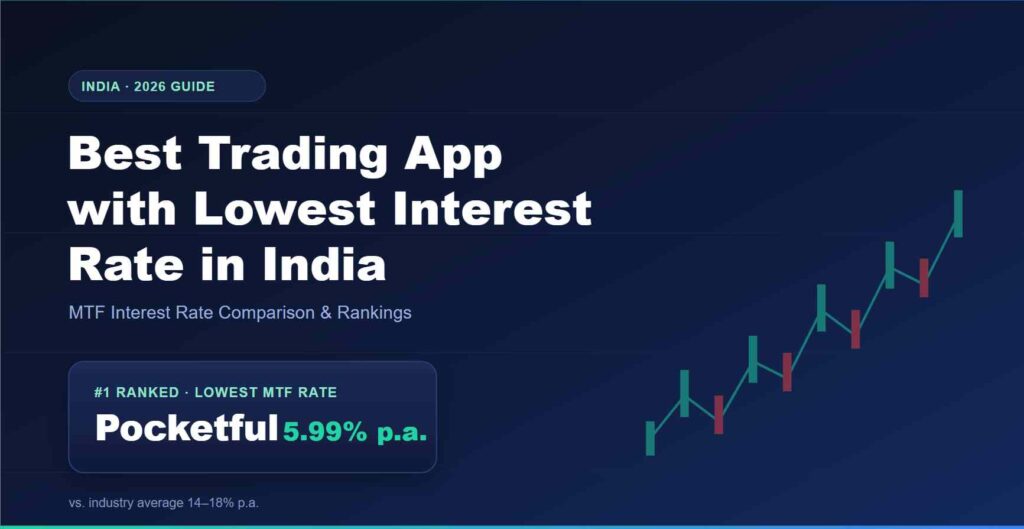
Quick answer: Pocketful currently offers the lowest MTF interest rate in India, starting at 5.99% p.a., roughly half of what most large brokers charge (14–18% p.a.).
What Is MTF and Why the Interest Rate Matters
Margin Trading Facility (MTF) is a SEBI-regulated mechanism that allows a stockbroker to fund a portion of your stock purchase, while you pay only a fraction of the total value upfront as margin. Think of it as a short-term, collateral-backed loan from your broker, secured against the very shares you buy.
For example, if a stock is trading at ₹1,000 and your broker offers 5x MTF leverage, you might only need to put up ₹200 of your own money, while the broker funds the remaining ₹800. In exchange for funding that ₹800, the broker charges you daily interest — the MTF interest rate — until you close the position or repay the borrowed amount.
Why this rate deserves more attention than most traders give it
- It compounds silently. Unlike brokerage, which is a one-time charge per trade, MTF interest accrues every single day a position remains open.
- It directly reduces your break-even point. The higher the rate, the further the stock has to move in your favor just to cover the cost of borrowing.
- It varies dramatically between brokers — from roughly 6% p.a. at the cheapest end to as high as 18% p.a. at the most expensive end, nearly a 3x difference.
- It disproportionately affects swing and positional traders who hold leveraged positions for weeks or months, rather than closing them intraday.
In short: two traders holding the exact same stock, same quantity, same entry and exit price, can end up with meaningfully different net returns purely because of which broker they used for MTF.
How MTF Interest Is Actually Calculated (With an Example)
MTF interest is typically calculated on a daily reducing basis on the funded (borrowed) amount, and billed to your account weekly. The formula brokers generally use looks like this:
Daily Interest = (Funded Amount × Annual MTF Rate) / 365Worked example:
Suppose you buy shares worth ₹2,00,000 using MTF, and you put up ₹40,000 of your own margin (5x leverage). The broker funds the remaining ₹1,60,000.
| Broker | MTF Rate (p.a.) | Daily Interest on ₹1,60,000 | Interest for 30 Days |
|---|---|---|---|
| Pocketful (5.99%) | 5.99% | ₹26.3 | ₹788 |
| Kotak Securities (~9.75%) | 9.75% | ₹42.8 | ₹1,285 |
| Zerodha (14.6%) | 14.6% | ₹64.1 | ₹1,924 |
| Angel One (14.99%) | 14.99% | ₹65.7 | ₹1,972 |
| 5paisa (16.425%) | 16.425% | ₹72.0 | ₹2,160 |
| Alice Blue (18%) | 18% | ₹78.9 | ₹2,367 |
On the exact same trade, held for exactly 30 days, the cost of borrowing ranges from ₹788 to ₹2,367 — nearly a 3x difference — purely based on which app you’re trading through. Scale that across a full year of active positional trading, and the gap becomes substantial.
Best Trading Apps in India by Lowest MTF Interest Rate — Comparison Table
| Rank | Broker | MTF Interest Rate (p.a.) | Approx. Daily Rate | Cost per ₹1 Lakh/Day | Leverage Offered | Brokerage (Delivery) |
|---|---|---|---|---|---|---|
| 🥇 1 | Pocketful | 5.99% (rises for higher slabs) | 0.0164% | ₹16.4 | Up to 5x | ₹0 |
| 2 | HDFC Securities | 12% | 0.0329% | ₹33 | Up to 4x | Plan-based |
| 3 | Lemonn | 10.95% | 0.0273% | ₹30 | Up to 4x | Low flat fee |
| 4 | Kotak Securities | ~9.75% (plan-based) | 0.026% | ₹26 | Up to 4x | Plan-based |
| 5 | Paytm Money | 9.75% – 14.99% (slab-based) | 0.026% – 0.041% | ₹26 – ₹41 | Up to 4x | ₹20/order |
| 6 | Dhan | 12.49% – 16.49% (slab-based) | 0.034% – 0.045% | ₹34 – ₹45 | Up to 4x | ₹0 |
| 7 | ICICI Direct | 9.69% – 17.99% (plan-based) | 0.026% – 0.049% | ₹26 – ₹49 | Up to 4x | Plan-based |
| 8 | m.Stock | 0.0192% – 0.0411%/day (slab-based) | up to 15% p.a. equiv. | ₹19 – ₹41 | Up to 4x | ₹0 |
| 9 | Zerodha | 14.6% | 0.04% | ₹40 | Up to 4x | ₹0 |
| 10 | Groww | 14.95% | 0.041% | ₹41 | Up to 4x | ₹20/order |
| 11 | Angel One | 14.99% | 0.041% | ₹41 | Up to 4x | ₹20/order |
| 12 | 5paisa | 16.425% | 0.045% | ₹45 | Up to 4x | Low flat fee |
| 13 | Mirae Asset Sharekhan | Up to 18% | 0.0493% | ₹49 | Up to 4x | Plan-based |
| 14 | Arihant Capital | 18% | 0.05% | ₹50 | Up to 4x | Plan-based |
| 15 | Alice Blue | 18% | 0.049% | ₹49 | Up to 4x | Flat fee |
Rates are indicative, sourced from broker websites and pricing pages as of mid-2026. MTF slabs typically apply lower rates to smaller funded amounts and higher rates as the borrowed amount increases — always confirm current slabs on the broker’s official pricing page before trading, since rates are revised periodically.
Detailed Broker-by-Broker Breakdown
1. Pocketful — Best Overall for Lowest MTF Interest Rate
MTF Interest Rate: Starting at 5.99% p.a.
Pocketful, operated by Pace Stock Broking Services (27+ years in the broking industry), currently holds the lowest publicly listed MTF starting rate among major Indian trading apps.
| Feature | Details |
|---|---|
| MTF Interest Rate | Starts at 5.99% p.a. (0.0164%/day) up to ₹1,00,000; rises in slabs for larger funded amounts |
| Leverage | Up to 5x on 1,200+ MTF-eligible stocks |
| Account Opening | ₹0, no AMC for lifetime of account |
| Brokerage | ₹0 on equity delivery; flat ₹20/order on intraday and F&O |
| Platform Tools | TradingView charts, advanced options chain, Scalper Mode, basket orders, smart order types |
| Algo Trading | Free API for building and automating strategies |
| Withdrawal | Same-day withdrawal facility |
| Pledge | Instant pledge for MTF activation |
Pros:
- Lowest starting MTF rate in the market by a wide margin
- Zero brokerage on delivery trades and zero AMC
- Modern charting and execution tools comparable to larger, more established brokers
- Free trading API, useful for algo traders
Cons:
- Smaller brand recognition compared to legacy players like Zerodha or Angel One
- Fewer years of public track record than full-service brokers like ICICI Direct or Kotak
Best for: Traders who actively use MTF/margin and want to minimize borrowing cost without sacrificing modern trading tools.
2. HDFC Securities
MTF Interest Rate: 12% p.a.
Backed by HDFC Bank, HDFC Securities markets its offering as “Buy Stocks Pay Later,” which functions as an MTF product at a comparatively moderate flat rate.
Pros: Strong brand trust, integrated banking, solid research reports.
Cons: Higher account and platform charges than pure discount brokers; MTF rate is still double Pocketful’s starting rate.
Best for: Investors who value banking integration and research over the lowest possible cost.
3. Lemonn
MTF Interest Rate: 10.95% p.a.
A newer discount broker gaining traction for its low-cost, no-frills platform.
Pros: Competitive rate, simple and fast platform.
Cons: Smaller feature set and community/support ecosystem compared to larger brokers.
4. Kotak Securities
MTF Interest Rate: ~9.75% p.a. (plan-dependent)
Backed by Kotak Mahindra Group, Kotak’s Trade Free Pro plan offers one of the more competitive MTF rates among full-service brokers.
Pros: Strong research and advisory support, trusted brand.
Cons: Rate depends heavily on which brokerage plan you choose; not the cheapest on default plans.
5. Paytm Money
MTF Interest Rate: 9.75% – 14.99% p.a. (slab-based)
Paytm Money uses a slab structure where smaller and very large book sizes actually get a better rate than the mid-range (₹1–25 lakh) slab.
Pros: Integrated with the wider Paytm ecosystem, simple onboarding, in-app chat support.
Cons: The mid-range slab (most retail traders) pays close to 15% — not genuinely “low cost” for typical position sizes.
6. Dhan
MTF Interest Rate: 12.49% – 16.49% p.a. (slab-based)
Dhan has built a strong following among active traders for its clean interface and TradingView integration, but its MTF cost rises steeply as funded amounts grow past ₹5 lakh, eventually reaching 16.49% p.a. for amounts above ₹50 lakh.
Pros: Excellent charting, fast execution, modern UX.
Cons: MTF becomes expensive quickly for larger positions.
7. ICICI Direct
MTF Interest Rate: 9.69% – 17.99% p.a. (plan-based)
Backed by ICICI Bank, ICICI Direct offers a 3-in-1 account (banking + trading + demat), with MTF cost varying widely depending on the brokerage plan selected.
Pros: Seamless banking integration, established full-service brand.
Cons: Wide rate range means many plans fall closer to the expensive end (up to 17.99%).
8. m.Stock (Mirae Asset)
MTF Interest Rate: Slab-based, roughly 7% – 15% p.a. equivalent
Backed by Mirae Asset Financial Group, m.Stock uses a reducing-slab model: the more you borrow, the lower your per-day rate becomes, which rewards larger, more serious traders.
Pros: Rate improves as book size grows; strong global backing.
Cons: Smaller retail traders don’t benefit from the best slabs.
9. Zerodha
MTF Interest Rate: 14.6% p.a.
India’s largest broker by active client count, known for the widely used Kite trading platform and its role in popularizing discount broking in India.
Pros: Extremely reliable infrastructure, huge community and educational content (Varsity), strong reputation.
Cons: MTF interest rate is more than double Pocketful’s starting rate; not competitive for margin-heavy strategies.
10. Groww
MTF Interest Rate: 14.95% p.a.
Known for its clean, beginner-friendly interface and massive retail user base, especially among first-time investors.
Pros: Very easy to use, strong mutual fund and SIP integration.
Cons: MTF cost is on the higher side; not ideal for margin-heavy or leverage-focused traders.
11. Angel One
MTF Interest Rate: 14.99% p.a.
A hybrid broker combining discount-broking pricing with AI-driven advisory (ARQ) and a wide product suite spanning equity, F&O, currency, and mutual funds.
Pros: AI-based recommendations, broad product range, established brand.
Cons: MTF rate is nearly 2.5x Pocketful’s starting rate.
12. 5paisa
MTF Interest Rate: 16.425% p.a.
A budget-focused broker known for low flat brokerage fees, though its MTF cost is comparatively high.
Pros: Low headline brokerage, decent feature set for the price.
Cons: One of the pricier MTF rates on this list.
13–15. Mirae Asset Sharekhan, Arihant Capital, Alice Blue
These brokers sit at the higher end of the MTF cost spectrum, generally in the 18% p.a. range. They may still appeal to traders who value their specific research offerings, legacy platform features, or existing banking relationships, but they are not competitive purely on MTF cost.
Real Cost Comparison: What a 2–10% Rate Gap Actually Costs You
It’s easy to dismiss a “few percent difference” as immaterial. The numbers say otherwise.
Scenario: A trader maintains an average MTF exposure of ₹5,00,000 across roughly 200 active trading days in a year.
| MTF Rate | Approx. Annual Interest Cost |
|---|---|
| 5.99% (Pocketful, entry slab) | ₹4,101 |
| 10% | ₹6,849 |
| 14.6% (Zerodha) | ₹10,000 |
| 16.425% (5paisa) | ₹11,247 |
| 18% (higher-cost brokers) | ₹12,329 |
The gap between the cheapest and most expensive option in this scenario is roughly ₹8,200 in a single year — money that never had to leave your account in the first place. Extend this over 2–3 years of consistent MTF usage, and the cumulative gap can exceed ₹15,000–₹20,000, before even accounting for the opportunity cost of not having that capital compounding elsewhere.
This is why serious traders increasingly treat MTF rate as a primary broker-selection criterion, not an afterthought behind brokerage fees or app design.
MTF Leverage Comparison Across Brokers
Interest rate isn’t the only variable — leverage (how much the broker is willing to fund relative to your margin) also affects your overall cost-efficiency and risk exposure.
| Broker | Typical MTF Leverage | Eligible Stocks (approx.) |
|---|---|---|
| Pocketful | Up to 5x | 1,200+ |
| Zerodha | Up to 4x | 900+ |
| Angel One | Up to 4x | 800+ |
| Groww | Up to 4x | 700+ |
| Dhan | Up to 4x | 900+ |
| 5paisa | Up to 4x | 600+ |
A broker offering higher leverage at a lower interest rate — as Pocketful does with 5x leverage at a 5.99% starting rate — generally offers the best combination of buying power and cost-efficiency, though higher leverage also means proportionally higher risk if a trade moves against you.
How to Choose the Right Low-Interest Trading App
Don’t stop at the headline MTF rate. Use this checklist before committing significant capital:
- Check the slab structure, not just the advertised starting rate. Many brokers quote an attractive rate that only applies to small funded amounts (e.g., up to ₹1 lakh); rates often rise steeply for larger positions. Pocketful’s 5.99% applies to the entry slab, with higher slabs for larger funded amounts — read the fine print for every broker you compare.
- Factor in brokerage + MTF interest together. A broker with a marginally higher MTF rate but zero brokerage might still work out cheaper overall depending on your trade frequency and holding period.
- Compare leverage limits, not just rates. A lower interest rate paired with lower leverage may not always be the better deal for traders who need maximum buying power.
- Check pledge/unpledge charges. MTF-purchased stocks are automatically pledged as collateral and unpledged on sale; some brokers charge extra per pledge/unpledge event, which adds to your real cost.
- Look at margin call handling. Understand how quickly a broker issues margin calls, how much time you’re given to top up, and what penalty applies if you’re late.
- Test with a small position first. Before committing large capital, open an account, execute one or two real MTF trades, and compare the actual charges against your existing broker’s statement.
- Consider platform reliability. A slightly higher rate might be worth it if the platform offers materially better order execution speed, uptime during high-volatility sessions, or charting tools you rely on.
How to Activate MTF on a Trading App (Step-by-Step)
While the exact flow varies slightly by broker, the general process to activate MTF looks like this:
- Open a trading and demat account with your chosen broker (most brokers, including Pocketful, offer this free with no AMC).
- Complete KYC verification — PAN, Aadhaar, bank account linking, and income proof where required.
- Sign the DDPI (Demat Debit and Pledge Instruction) or equivalent authorization, which allows the broker to pledge MTF-purchased shares as collateral.
- Enable MTF from your account settings — this is usually a toggle or a one-time activation request within the app.
- Check the MTF-eligible stock list — not all stocks qualify for margin funding; eligibility is determined by SEBI and exchange guidelines plus the broker’s own risk policy.
- Place your MTF order — most apps let you select “MTF” as the order type at the time of placing a buy order, automatically calculating the required margin versus the funded amount.
- Monitor interest accrual and margin utilization — a good MTF dashboard (like Pocketful’s) shows per-position interest, funded amount, and margin health in real time.
Risks of Trading on Margin You Shouldn’t Ignore
Lower interest rates make MTF cheaper, but leverage itself carries risk regardless of which broker you use:
- Amplified losses: Just as leverage magnifies gains, it magnifies losses. A small adverse price move can result in a proportionally larger loss on your invested capital.
- Margin calls: If the value of your pledged shares falls below the required maintenance margin, the broker will ask you to add funds quickly — often within the same trading day.
- Forced liquidation: If you don’t meet a margin call in time, the broker can sell your shares at the prevailing market price, potentially locking in a loss you didn’t choose.
- Interest accumulation on losing positions: If a trade moves against you and you hold on hoping for a reversal, MTF interest keeps accruing daily, compounding your losses.
- Not suited for beginners: MTF assumes you already understand technical risk management, stop-losses, and position sizing. It is generally not recommended for traders new to the market.
- Volatility risk: Using leverage on high-beta or highly volatile stocks significantly increases the odds of a sudden, sharp adverse move triggering a margin call.
MTF vs. Regular Delivery Trading — Which Should You Use?
| Factor | Regular Delivery Trading | MTF Trading |
|---|---|---|
| Capital Required | Full trade value upfront | Fraction of trade value (margin only) |
| Buying Power | Limited to your own funds | Amplified — up to 4x–5x |
| Ongoing Cost | None beyond brokerage | Daily interest on funded amount |
| Risk Level | Lower — losses limited to capital invested | Higher — losses can exceed initial margin |
| Best Suited For | Long-term investors, beginners | Experienced traders seeking short-to-medium term amplified exposure |
| Holding Period | Any duration, no added cost | Best for shorter holding periods — interest erodes returns on long holds |
If you’re a long-term investor building a portfolio over years, MTF’s daily interest cost will likely outweigh any benefit — plain delivery trading is more appropriate. MTF makes the most sense for traders with a defined thesis and a realistic, relatively short holding horizon, where the potential gain clearly outweighs the accumulated interest cost.
Conclusion
If minimizing your cost of borrowing is the top priority, Pocketful’s 5.99% p.a. starting MTF rate currently makes it the best trading app with the lowest interest rate in India — nearly half the cost of large, well-known brokers like Zerodha, Angel One, and Groww. HDFC Securities, Lemonn, and Kotak Securities round out a competitive second tier for traders who want a moderate rate paired with strong brand backing or research support.
That said, interest rate should be one input into your decision, not the only one. Match your choice of broker to your actual trading style: short-term active traders benefit most from a genuinely low, stable MTF rate; long-term investors are usually better served by plain delivery trading altogether, where interest cost doesn’t apply at all.
Always confirm the latest slab-wise MTF rates directly on each broker’s official pricing page before opening a leveraged position, since these rates are revised periodically and can change without much public notice.
Frequently Asked Questions
Which trading app has the lowest MTF interest rate in India?
Pocketful currently offers the lowest MTF interest rate in India, starting at 5.99% p.a. — significantly below the industry average of 14–18% p.a.
What is a “good” MTF interest rate?
Generally, a rate between 6–10% p.a. is considered competitive in the current Indian market. Rates above 14–18% p.a. meaningfully increase your holding cost, especially for positions held more than a few weeks.
Is a lower MTF rate always the best choice of broker?
Mostly yes for active margin traders, but not exclusively. Also weigh brokerage charges, leverage limits, platform reliability, pledge/unpledge fees, and customer support quality — not interest rate in isolation.
How often is MTF interest charged and deducted?
Interest accrues daily on the funded amount but is typically billed and deducted from your trading account on a weekly basis, varying slightly by broker.
Can beginners use MTF?
It’s generally not recommended for beginners, since leverage magnifies both gains and losses. It’s better suited to traders who already understand margin risk, stop-loss discipline, and position sizing.
For how long can I hold MTF positions?
Most Indian brokers allow MTF positions to be held for an unlimited time, as long as margin requirements are maintained — but remember that interest keeps accruing daily, so very long holding periods can erode profitability.
What happens if I get a margin call?
You’ll need to add funds to your account quickly — often within the same trading day — to meet the maintenance margin requirement. If you fail to do so, the broker may liquidate your position to cover the shortfall, sometimes along with a margin call penalty.
Do all brokers offer the same stocks for MTF?
No. MTF-eligible stocks vary by broker based on SEBI/exchange rules and the broker’s internal risk policy. It’s worth checking a broker’s specific MTF-eligible stock list before assuming a particular stock qualifies.
Are there additional charges besides the interest rate?
Yes — check for pledge and unpledge charges (since MTF shares are automatically pledged as collateral and unpledged when sold), along with standard brokerage, STT, GST, and other statutory charges that apply to any trade.
How is MTF interest different from F&O margin costs?
MTF applies specifically to cash-market equity delivery purchases funded by the broker. Futures & options trading uses a different margin framework (SPAN + exposure margin) and generally does not involve a daily “interest rate” in the same way, though leverage risk applies similarly.
This article is for educational purposes only and does not constitute investment advice. MTF/margin trading involves the risk of amplified losses; please review official broker terms and consult a qualified financial advisor before trading with leverage.